Bring Your Own Agent: Introducing mcp.stlabs.com
 Kiarash Adl
AI assistants like Claude and ChatGPT are where a lot of work now starts — asking questions, digging into problems, figuring out what's actually going on. But they're built for thinking, not doing. Whatever you work out in a chat still lives outside the systems where the work actually gets tracked and approved. So you copy, paste, and rebuild your reasoning by hand just to turn an idea into action.
We built mcp.stlabs.com to close that gap. The STLabs platform is still the home for service management across IT, HR, and Finance; the MCP server just makes it reachable from wherever your thinking starts. Explore in the assistant you already use, then act in STLabs, without breaking your train of thought by switching windows.
A Monday morning problem
Monday, 8:00 AM. The operations review is in two hours, and an IT leader's inbox is a graveyard of vague complaints: "VPN is unstable," "SSO keeps timing out." The sales team is panicking, and the quarter closes in two weeks. She doesn't have time to manually hunt down the source of all these issues.
She pastes the chaos into Claude: Help me understand if this is a trend or just noise.
Claude quickly spots that these aren't one-off instances, but a pattern: authentication failures happening right after devices wake from sleep. The catch is that Claude can't see the live state of her environment — the open tickets, who owns them, and what changed recently.
She prompts: Check STLabs for related tickets and recent work connected to these symptoms.
Through the STLabs MCP server, Claude is able to identify some relevant context. It surfaces 43 existing tickets that are related to the Slack messages; a recent gateway configuration change, and an outdated troubleshooting article. Suddenly, this problem goes from an unresolved "potential VPN issue" to a complete root-cause analysis.
With one final task, she turns the insight into action: Create a parent ticket in STLabs, link these 43 incidents, and kick off the necessary workflows.
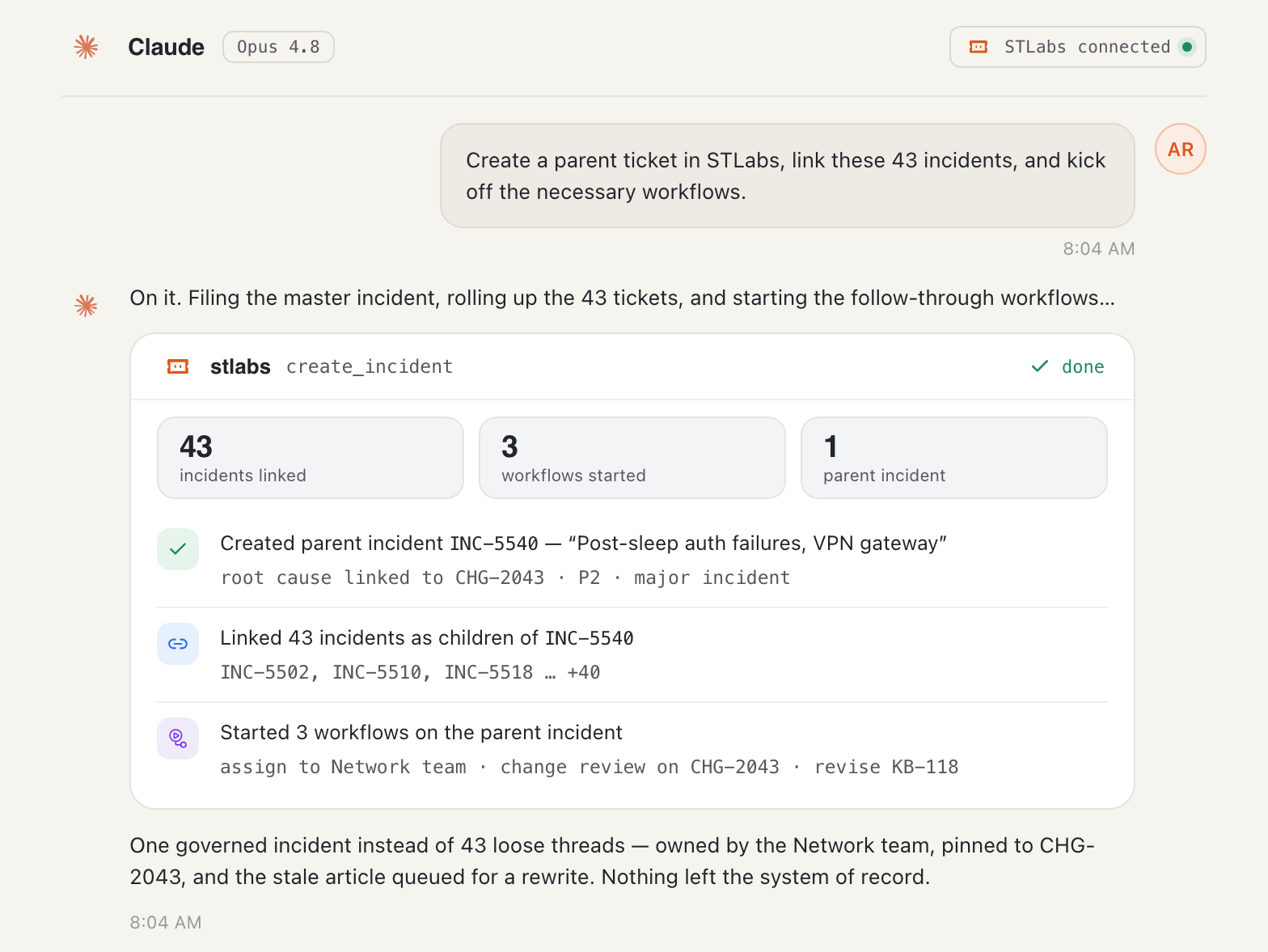
Seconds later, the work is live. The master incident exists, the relevant teams are aligned, and the work is governed. She never left her train of thought, and she didn't have to spend time manually bridging the gap between reasoning and execution.
She never had to leave Claude while she was thinking. The moment the conversation became operational, STLabs took over. The value isn't that an assistant can create a ticket in STLabs, but rather that a messy conversation became governed IT work without losing context, bypassing ownership, or spawning another shadow process outside the system of record.
Why MCP and where it fits
We built our MCP server specifically for all the messy, ad hoc, multi-system investigations that don't always start with a clear ticket in a formal system of record. An HR coordinator untangling what's blocking a new hire's setup across access, equipment, and approvals. A finance dashboard failing intermittently for days, where the real question isn't "is there a ticket?" but "what does this depend on, what changed, and are there any tickets across those dependencies that explain the pattern?"
In those moments, the work starts in exploration mode with an AI assistant that's completely separate from STLabs. MCP lets whatever assistant you're already in pull the knowledge that used to be locked inside STLabs, so you don't stop, switch tools, and rebuild your thinking at every step. And when it's time to act, MCP hands your agent a real toolkit — one that knows who owns what, who's allowed to do what, and how the work gets tracked.
Governed access, not another shadow channel
Enterprise AI must be governed, not shadowed. With mcp.stlabs.com, agents act directly through the user's STLabs account. This means the agent authenticates as the user and can only ever do what that user could already do themselves. Every action inherits existing permissions, visibility rules, and audit trails, and lands in the same log as any other work. By design, there is no parallel access model to defend, just the same enterprise-grade security you already trust, extended to your agentic workflows.
That's the line between useful enterprise AI and unmanaged AI. Unmanaged AI produces outputs that someone copies into an operational system later, if they remember. Useful enterprise AI connects the moment of insight to the system where action can be taken responsibly.
Wherever work starts
The future isn't a single chat window; it's a distributed ecosystem where thinking and doing happen in different places. We don't expect every insight to start in STLabs, but we do ensure every action ends up there. Our goal is to meet users wherever work begins. mcp.stlabs.com ensures that while reasoning can happen anywhere, execution remains governed and recorded in STLabs as the essential home for service management.
To get started, point your assistant at mcp.stlabs.com and try it on your next investigation.